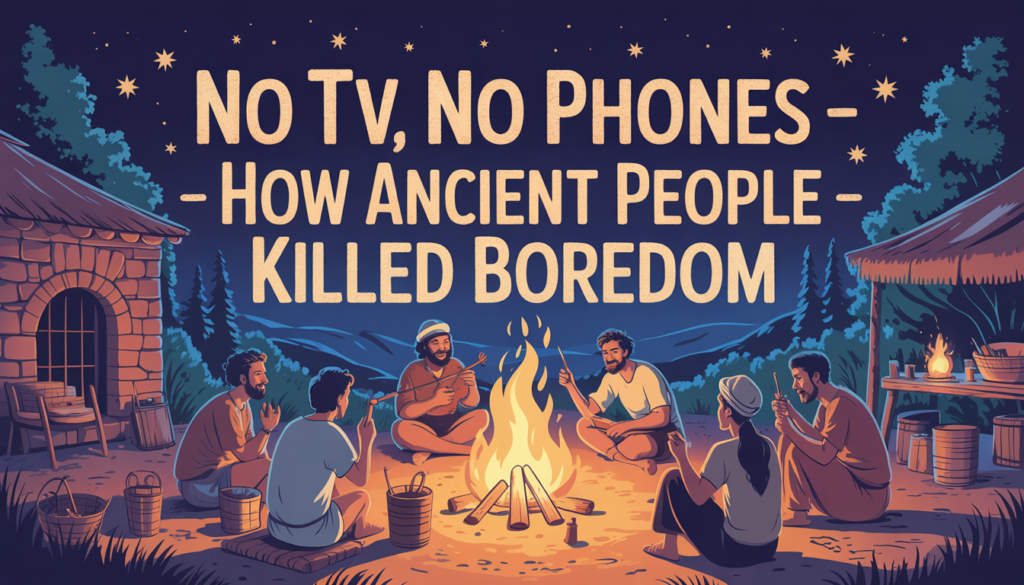
Right now, you have 47 apps on your phone, a streaming service with 10,000 things to watch, a podcast for every topic that has ever existed, and somehow you still get bored. So here’s a question nobody thinks to ask. What did ancient humans do when they were bored? Not medieval humans, not ancient Romans, not even ancient Egyptians. We’re going back further than that. 100,000 years, 200,000 years, back when there was no writing, no art, no music, no language as we know it. just people sitting there with nothing to do. The answer changes everything we think we know about creativity, religion, and why your brain works the way it does.
Did Ancient Humans Even Get Bored?
But first, did boredom even exist back then? This is actually a serious scientific debate. For a long time, researchers assumed our earliest ancestors were too busy surviving to get bored. Every waking hour was hunting, foraging, and building shelter. There was no downtime. But that assumption turned out to be wrong. Very wrong. In 1966, anthropologist Marshall Sahlins published a paper that flipped everything. He had spent years studying the ǃKung people of the Kalahari Desert, one of the last groups on Earth still living something close to the original human lifestyle.
What he found was this. They worked on average about 15 to 20 hours per week. That’s it. Not per day, per week. The rest of the time, they rested, they talked, they sat, they did nothing in particular. Sahlins called them the original affluent society, not because they had stuff, but because they had time, more free time than most modern humans ever get. So, the question isn’t whether ancient humans got bored. The question is, what happened when they did?
Boredom Invented Art and Music:
Let’s start with the obvious one. They played. This sounds simple. It isn’t. In 2010, archaeologist Franchesco Dero and his team studied a collection of shells found at a site in South Africa called Blomos Cave. The shells were 75,000 years old. They had holes drilled through them, and they were coated in red ochre. These weren’t tools. They weren’t weapons. They weren’t food. They were beads. Someone had sat down 75,000 years ago with nothing better to do and made themselves jewelry. That’s the oldest known art object in human history. And it started with boredom.
But here’s what’s really interesting. Making those beads would have taken hours, maybe days. Drilling through a shell with a stone tool, without electricity, without metal, without patience built by a lifetime of entertainment. That was a long afternoon, and they did it anyway. Because the alternative was staring at the wall of a cave. Necessity didn’t invent art. Boredom did. The same pattern shows up in music.
In 2008, researchers excavating a cave in southern Germany found a flute. It was made from the bone of a vulture. It had five finger holes. It was 40,000 years old. Someone 40,000 years ago, before agriculture, before cities, before any civilization we would recognize, sat down and invented music. Not because they had to, but because they had a free afternoon and a bird bone.
And it turns out music is what the brain does when it has nothing else to process. Neuroscientist Daniel Levton, who studies the origins of music, argues that musical ability is older than language. Our brains were wired for rhythm and melody before we could form complex sentences. Because rhythm is pattern recognition, and pattern recognition keeps us alive.
Boredom Invented Imagination:
But boredom didn’t just invent art and music. It invented something far more powerful. It invented imagination. Think about this. You cannot be bored without a concept of time. To be bored, you have to know that this moment is lasting too long. That something else could be happening. The future exists, and it could be better than right now. Boredom is, in a very real sense, the first sign that a brain has developed the ability to imagine things that don’t exist yet. Animals don’t get bored the way humans do. A dog waiting for its owner isn’t bored. It’s just waiting. It doesn’t have a concept of what else it could be doing.
But a human sitting in a cave 100,000 years ago, staring at the fire, nothing to do, starts to think, “What if the hunt goes wrong tomorrow? What if that sound outside is a predator? What’s beyond that mountain? Where do we go when we die?” Every question religion has ever asked, every question philosophy has ever asked, every question science is still trying to answer, all of them started the same way.
The Science of Boredom and Creativity:
Someone was bored, and their mind started wandering. In 2013, psychologist Sandy Man published research showing that boredom significantly increases creative output. She had people perform the most boring task she could devise, copying numbers from a phone book, and then tested their creativity immediately afterward. The bored group dramatically outperformed everyone else because boredom forces the brain to generate its own stimulation. And the brain, when left to its own devices, is extraordinary.
Boredom Invented Gossip and Society:
But there’s one more thing ancient humans did when they were bored. And it’s the one that mattered most. They talked, not about hunting, not about food, not about logistics. They told stories. Anthropologist Robin Dunbar, the same researcher who discovered that human social groups naturally cap at around 150 people, spent years studying what humans talk about when they’re not talking about anything important. His finding, roughly 65% of all human conversation is social gossip. Who did what, who said what, what happened to someone you both know.
This sounds like a waste of time. It wasn’t. Dunbar argues that language itself evolved not for practical communication, but for social bonding. Before language, primates bonded by physically grooming each other, but grooming takes time. It’s one-to-one. You can only groom one friend at a time. Language replaced grooming. Now you could bond with three people at once. 10. A whole group around a fire. You could tell a story about someone who wasn’t even there. You could build trust with people you’d never met.
Language and, therefore, human civilization didn’t emerge because we needed to coordinate hunts. It emerged because we were sitting around with nothing to do, and we started talking about each other. Boredom invented gossip, and gossip invented society.
What We Lost When We Killed Boredom:
So, here’s where we’ve ended up. 75,000 years ago, someone bored in a cave made a bead. 40,000 years ago, someone bored in a different cave made a flute. And somewhere in between, people sitting around fires with nothing to do started asking questions no one had answers to, about death, about the sky, about why things are the way they are. And some of those questions became religion. Some of them became science. Some of them became art. Some of them became you. Lying awake at 2 a.m. with your phone on your chest, thinking about nothing in particular.
Here’s the part nobody talks about. Modern psychology has a term for what happens when you eliminate boredom completely. They call it cognitive overload. When every moment is stimulated, the brain never gets the chance to do what it was built to do in the quiet moments. Process, consolidate, create. The default mode network, the part of your brain that activates when you’re doing nothing, is the same network responsible for creativity, self-reflection, and empathy. It only turns on when you’re bored. We spent 300,000 years learning to fill silence with something meaningful. Then we invented the smartphone, and we’ve been filling the silence ever since.
Conclusion:
But every time you put the phone down and sit with nothing for a moment, every time your mind starts to wander, and you let it, you’re doing the same thing the person in the cave was doing. The same thing that made the bead. The same thing that made the flute. The same thing that looked up at the stars and started asking why. Boredom didn’t hold ancient humans back. It’s what made them human. And it might be doing the same thing for you if you let it.
FAQs:
1. How many hours per week did ancient humans work?
About 15 to 20 hours per week.
2. What is the oldest known art object in human history?
75,000-year-old shell beads found in Blombos Cave, South Africa.
3. How old is the oldest known musical instrument?
40,000 years old, a vulture-bone flute from a cave in Germany.
4. What part of your brain activates when you’re bored?
The default mode network.
5. What percentage of human conversation is social gossip?
Roughly 65%.
6. What happens when you eliminate boredom completely?
Cognitive overload, where the brain never gets to process, consolidate, or create.
